 EN
EN
BKS Cepu Block Attends Inauguration of Infill and Clastic Banyu Urip Wells
- Home
- BKS Cepu Block Attends Inauguration of Infill and Clastic Banyu Urip Wells
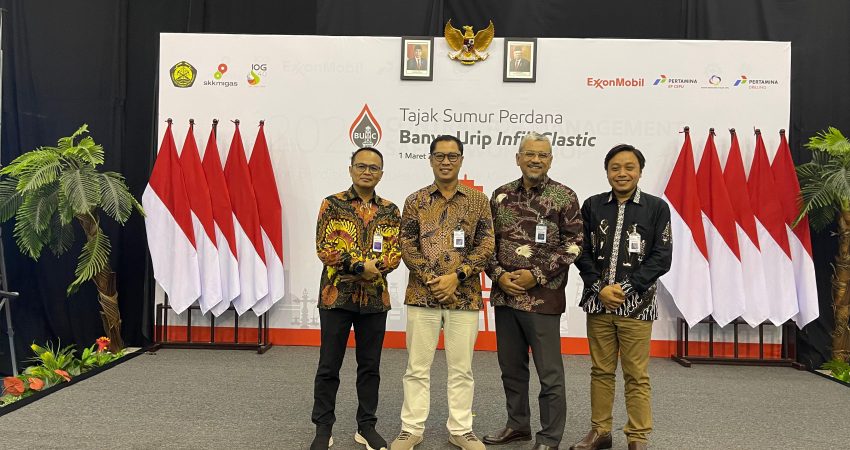
The spudding ceremony for the Banyu Urip infill and clastic wells was officially inaugurated by the Minister of Energy and Mineral Resources (ESDM), Arifin Tasrif. The drilling of the infill carbonate wells is part of the drilling campaign in the Cepu Block, which is being executed by ExxonMobil starting from 2024 until 2026, comprising the drilling of 5 infill carbonate wells and 2 clastic wells.
This drilling activity is being carried out between existing production wells in the Banyu Urip field to recover oil that could not be reached by previous wells, while simultaneously proving the presence of clastic reservoir reserves (sandstone reservoirs). This activity is expected to increase the Banyu Urip field’s production by 42 million barrels, thereby boosting oil output from the field, which currently contributes approximately 25% of the national oil production.
The Minister of ESDM, Arifin Tasrif, Delivered Remarks and Officially Inaugurated the Spudding of the Banyu Urip Infill and Clastic Wells.
Accompanying the Minister during the visit were the Acting Regent of Bojonegoro, Adriyanto; the Director General of Oil and Gas, Tutuka Ariadji; the Head of SKK Migas, Dwi Soetjipto; the Deputy for Exploitation at SKK Migas, Wahju Wibowo; the Deputy for Business Support at SKK Migas, Rudi Satwiko; the Vice President Director of PT Pertamina, Wiko Migantoro; the Risk Management Director of PT Pertamina, Ahmad Siddik Badrudin; the President of ExxonMobil Cepu Limited, Carole J. Gall; the President Director of PT Pertamina Hulu Energi, Chalid Salim Said; the President Director of PT Pertamina EP Cepu, Muhamad Arifin; and the Head of the BKS PI Cepu Block, Suko Hartono.
In his speech and direction, the ESDM Minister expressed his appreciation for ExxonMobil Cepu Limited (EMCL), which has managed to maintain optimal production in this block. The block’s initial potential was 400 million barrels, yet it has already yielded 630 million barrels to date and holds the potential to reach up to 1 billion barrels. Currently, production in the block is beginning to decline, which is why the stakeholders are committed to sustaining Banyu Urip’s production.
“Currently, 7 wells are planned for drilling, compared to eight years ago when there was no drilling at all. The hope is that the Clastic field has the same potential as the Carbonate field, which has a potential of up to 1 billion barrels,” said ESDM Minister Arifin Tasrif.
The ESDM Minister expects the infill and clastic well drilling activities to add between 20,000 and 30,000 barrels per day, thereby arresting the rate of production decline. Furthermore, it is hoped that the Clastic field will eventually achieve the same level of production as the Carbonate field.
“We are proud to continue our cooperation with Exxon, as the world’s largest company with formidable experience and technology. We continue to collaborate with Exxon, including on carbon capture cooperation and other planned Exxon investments in Indonesia. We expect the maximum possible output from the Cepu field,” he stated.
Meanwhile, the Head of SKK Migas conveyed that SKK Migas is paying great attention to efforts to keep oil production in the Banyu Urip field optimal. He stated that the Banyu Urip field’s production has exceeded the target set in the Plan of Development (POD). This success is due to various efforts and breakthroughs made by SKK Migas and ExxonMobil in maintaining the Banyu Urip block’s performance. “The spudding of the Banyu Urip infill carbonate well is a continuous effort by SKK Migas and ExxonMobil as the operator to increase oil production by 42 million barrels, while carefully considering the capacity and support of the existing reservoir,” explained the Head of SKK Migas, Dwi Soetjipto.
“I express my appreciation to EMCL and Pertamina Drilling Service Indonesia for fulfilling their commitment to carry out the drilling campaign by accelerating the commencement of drilling activities, which were originally slated to begin in September 2024. We pushed for it to be accelerated to February 2024, and thankfully, it could be executed on 1 March 2024,” he remarked.
Furthermore, he conveyed that today’s visit was certainly not just about reviewing the infill carbonate well spudding, but more importantly, it demonstrates the concern and aspiration of the Ministry of ESDM and SKK Migas to encourage increasingly optimal operational performance in the Banyu Urip Block. “As a field contributing approximately 25% of the national oil production, Banyu Urip’s contribution is highly anticipated in achieving the future production target of 1 million barrels of oil per day (BOPD) by 2030, in support of national energy security,” he added.
On the same occasion, President of ExxonMobil Indonesia, Carole Gall, stated that the Banyu Urip Infill and Clastic Project, or what is commonly known as the BUIC Project, is of immense importance. This project will significantly contribute to the aspiration we fully support: achieving the national target of 1 million barrels of oil per day production by early 2030, which will simultaneously strengthen national energy security.
In line with the drilling campaign plan, the drilling of 2 infill carbonate wells scheduled for 2024 is projected to begin onstream this year through tie-in to existing facilities. This will be followed by the drilling of 3 infill carbonate wells and 2 clastic wells over the period up to 2025, and they are expected to be onstream in 2026.
The Banyu Urip drilling campaign activities utilise rigs and equipment entirely manufactured in Indonesia and are operated by PT Pertamina Drilling Services Indonesia (PDSI), a subsidiary of PT Pertamina (Persero). This drilling demonstrates PDSI’s competence in oil and gas drilling, as well as the support of the upstream oil and gas industry for the growth and development of national companies, and the commitment of SKK Migas and KKKS (Contractors for Cooperation) to implementing the Local Content Level (Tingkat Komponen Dalam Negeri - TKDN) in the upstream oil and gas industry.
Also on the same occasion, the Head of the BKS PI Cepu Block, Suko Hartono, stated that the BKS PI provides full support for this drilling campaign. “The BKS PI Cepu Block certainly hopes that this production increase will make an optimal contribution to achieving the national oil and gas production target, while also strengthening collaboration among all stakeholders, which will ultimately enhance the welfare and development of the community around the operational area,” explained Suko Hartono, Head of the BKS PI Cepu Block.
Comment (0)
Other Post
-
-
BKS PI Cepu Block Roadshow to Blora Regency
15 March 2023 -
-
Discuss Oil and Gas, BKS Cepu Block Goes to Campus
27 November 2023 -

Leave a Comment