 EN
EN
BKS Cepu Block Holds Oil and Gas Practitioner Lecture Attended by Acting Regent of Bojonegoro
- Home
- BKS Cepu Block Holds Oil and Gas Practitioner Lecture Attended by Acting Regent of Bojonegoro
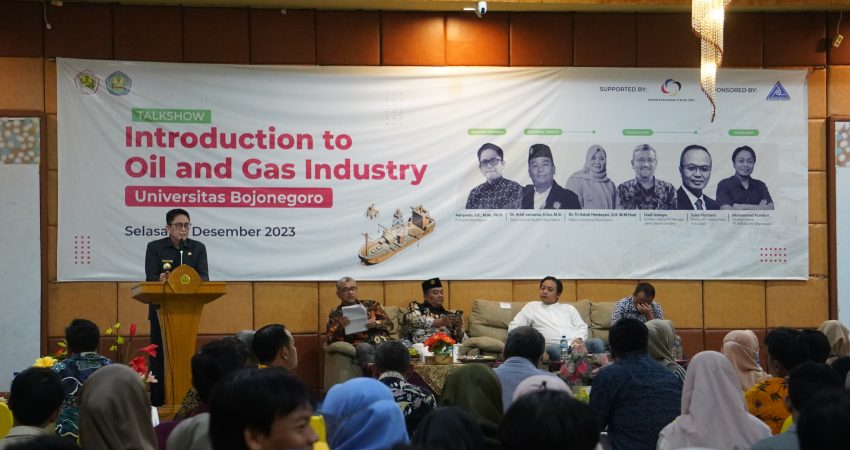
The Badan Kerja Sama (BKS) Cepu Blok once again held an oil and gas practitioner lecture in Bojonegoro entitled Introduction to the Oil and Gas Industry. This second oil and gas practitioner lecture was held at Bojonegoro University (Unigoro).
As an effort to introduce the oil and gas industry at the academic level in Bojonegoro, this practitioner lecture was attended by hundreds of students and opened with a keynote speech by the Acting Regent of Bojonegoro, Adriyanto, SE., MM., Ph.D.
According to the Acting Regent of Bojonegoro, the impact of the oil and gas industry is very complex. However, the industry is also full of uncertainty. This is because the main raw material is found underground and must be extracted using special technology. This technology is only owned by foreign companies. Oil extracted from Bojonegoro cannot be sold immediately. Adriyanto encourages the development of a downstream oil and gas industry to increase its selling value. "Technically, after the oil is extracted in Bojonegoro, it is transported to Tuban to be stored at the Gagak Rimang Floating Storage and Offloading (FSO) facility, then processed at the East Kalimantan refinery. However, the added value is not significant because we only produce raw materials. Hopefully, the knowledge shared by the speakers today can be absorbed well, and the students will actively ask questions. Because Unigoro is a treasure trove of knowledge," he explained.
There were two speakers at the practitioner lecture, which was moderated by Mohammad Kundori, President Director of PT. ADS Bojonegoro. They were Hadi Ismoyo, President Director of PT. Petrogas Jatim Utama Cendana, and Suko Hartono, Director of PT. Sarana Patra Hulu Cepu.
Speakers introducing the oil and gas industry, from left: President Director of PT PJUC, President Director of PT ADS, Director of PT SPHC
In front of the students, Hadi revealed that there are many petroleum resources in the Bojonegoro area and its surroundings that have not been exploited. However, he emphasised that oil exploitation activities must be accompanied by a conducive environment and investment commitment. ‘There are still many resources in Bojonegoro, Nganjuk, Ngawi, and Blora. But we must invite investors for exploitation. The Bojonegoro Regional Government must also be friendly to investors to provide convenience in investing,’ he said.
He added that there are several oil and gas business opportunities in Bojonegoro that can be explored. These include upstream, downstream, logistics supply, and services businesses. ‘The most important thing is that you must improve your skills, actively participate in various forums to learn networking, and learn about oil and gas from a technical and regulatory perspective,’ added Hadi.
Meanwhile, Suko talked a lot about the impact of oil and gas downstreaming. According to him, the most capital spent on downstreaming is on the refinery process. In Bojonegoro itself, there is already a mini refinery owned by PT. Tri Wahana Universal (TWU) in Kalitidu District. "The refinery at PT. TWU is ready. But we also have to prepare the human resources so that the oil refinery company can continue to exist," he said.
He also advised the Bojonegoro Regional Government to exploit liquefied natural gas or LNG. LNG can replace liquefied petroleum gas (LPG), which is in high demand by the community. With the hope that Bojonegoro can become an energy-independent region. ‘The challenge for Bojonegoro today is to prepare the infrastructure, human resources, and ease of licensing for investment in the downstream oil and gas industry,’ said Suko.
The Vice Rector III for Student Affairs and Cooperation, Ir. H. Noor Djohar, MM., expressed his gratitude to PT. ADS Bojonegoro for their cooperation in organising the practitioner lecture. A similar sentiment was expressed by the Chairman of the Suyitno Bojonegoro Foundation, Dr. Arief Januwarso, S.Sos., M.Si. He explained that Unigoro requires each study programme to hold practitioner lectures at least four times per semester.
Comment (0)
Other Post
-
-
BKS PI Cepu Block Roadshow to Blora Regency
15 March 2023 -
-
Discuss Oil and Gas, BKS Cepu Block Goes to Campus
27 November 2023 -

Leave a Comment